

Safeguarding the living heritage to reinforce sites conservation and biodiversity
From 10 to 28 January 2024, Earth Network volunteer experts Deirdre Prins-Solani, Olga Laiza Kupika and Elizabeth Matilda Abena Mantebeah visited the Asante Traditional Buildings in Ghana. Found in villages near Kumasi, these are the last material remains of the great Asante civilization, and they were inscribed on UNESCO’s World Heritage list in 1980. The objective of this mission was to strengthen the capacities of communities to identify, document and safeguard the intangible cultural heritage associated with the sites, as well as to investigate how they might contribute to the biodiversity of the sites and associated natural areas. It also aimed to develop a conservation management plan for these World Heritage properties.
Asante Traditional Buildings
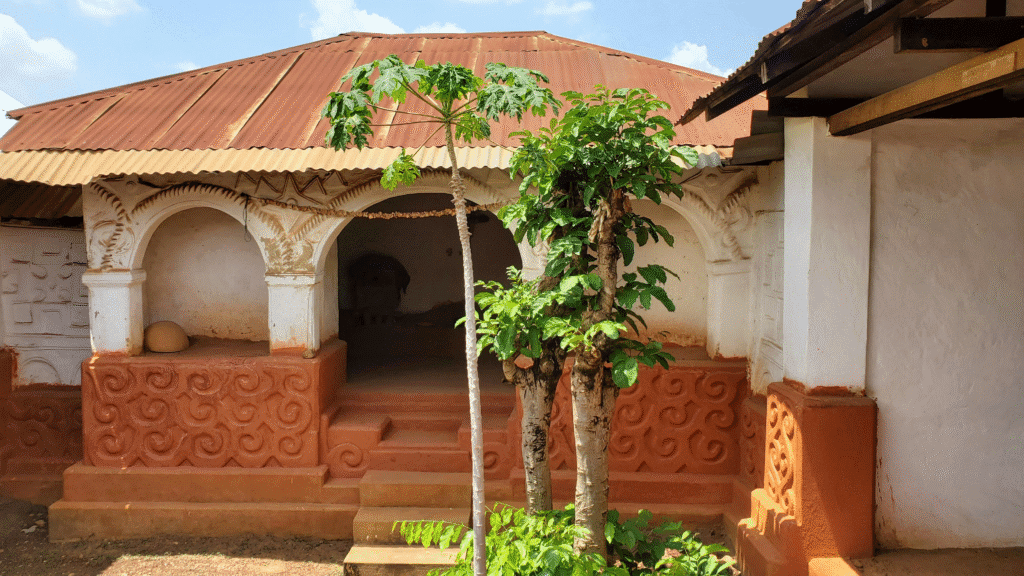
The Asante Traditional Buildings consist of 10 unique traditional shrines/fetish houses geographically located in the Ashanti Region of Ghana, Kumasi: Abirim, Asawase, Asenemaso, Bodwease, Ejisu Besease, Adarko Jachie, Edwenase, Kentinkrono, Patakro and Saaman. They are the last remaining testimony of the great Asante civilisation, which reached its peak in the 18th century, and some continue to have a religious function today, but their maintenance requires substantial conservation action.
Asante Traditional Buildings are earthen architecture structures made of traditional building materials –timber, bamboo and mud plaster– adorned with traditional Akan decorations (Adinkra symbols). Their indigenous design and building techniques reflect a cognisance of environmental factors such as the flow of cool air on hot days and sophistication in the use of materials such as bamboo to make the inner core of the bas-relief decorations.
4/5

Adako Jachie – Asante Traditional Buildings, Ghana
© UNESCO

Edwenase – Asante Traditional Buildings, Ghana
© UNESCO

Saaman – Asante Traditional Buildings, Ghana
© UNESCO

Kentinkrono – Earth Network mission to Asante Traditional Buildings, Ghana 2024
© UNESCO

Bodwease – Asante Traditional Buildings, Ghana
© UNESCO
Such traditional earth and wattle-and-daub buildings are particularly vulnerable to the onslaught of time, weather, and insects like termites. In order to best support their conservation, it was important that the experts study the relationship between the intangible and tangible heritage of the sites; and analyse activities and actions undertaken to safeguard the intangible cultural heritage directly and indirectly related to the Asante Traditional Buildings. The experts also identified threats to the conservation of local biodiversity, including climatic and non-climatic threats in and around Asante Traditional Buildings and their implications for the safeguarding of intangible cultural heritage. Their assessment outlines the impacts of climate change on biodiversity, intangible cultural heritage, and sustainable development, among others.
Assessments of current threats and hazards
The site conservation is intrinsically linked to the living heritage and the values associated with the site by the local communities, who consider that Asante Traditional Buildings are part of their heritage and identity. The biodiversity (flora and fauna) of the sites plays an integral role in the life of the communities and their relation to the sites. Conservation management plans and practices must consider the local biodiversity’s interrelationship with the cultural practices, beliefs and local knowledge associated with sites. The dichotomy between natural and cultural heritage, often perpetuated in management processes, is inappropriate for sites such as the Asante Traditional Buildings.
Several structures on the sites are clearly falling victim to the passage of time. Some structures have started to crumble, leading to socio-economic impacts. For instance, tourism was severely affected at Adako Jachie, although the Ghana Museums and Monuments Board (GMMB) intervened and undertook renovations in a timely manner.
Anthropogenic and climate-induced threats are endangering some of the sites’ unique ecological characteristics, with a loss of biodiversity (including flora and fauna in Adako Jachie) and habitats, as well as associated living heritage. For example, the intensification of agricultural developments makes the traditional building materials of thatch, bamboo, and specific timber species less easy to obtain. Some water bodies with cultural significance are drying up or heavily polluted, including the water source used for the preparation of the deity’s food at Asawase (Asawasi).
In addition, some socio-economic factors impact both youth and gender-related issues, such as high youth unemployment. In some communities drug and alcohol use have been identified by community members as a growing problem among young people, as well as gender-based violence issues.