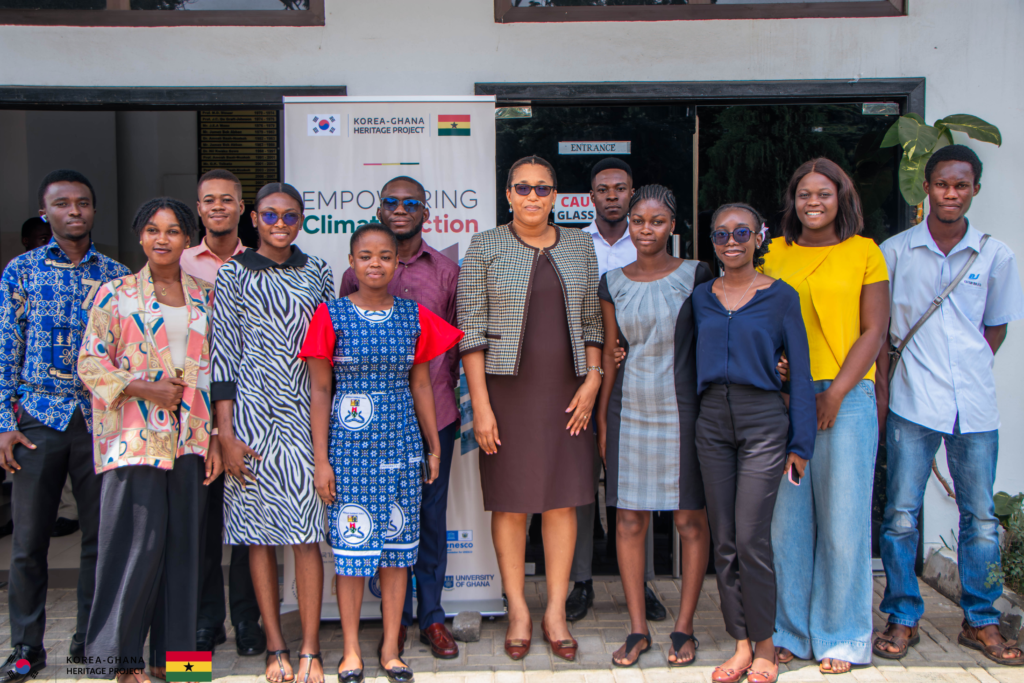
The World Heritage Committee itself has recognized the role of universities and experts in Ghana’s heritage management. In its 2021 decision, the Committee encouraged the development of an inventory with participation from national and international universities and experts.
The Ghana–Korea project goes further by explicitly identifying academia as part of the climate-heritage ecosystem.
Possible University Student Research Agenda
Universities could establish a “Climate and Heritage Research Lab” linked to the project.
Potential student research topics could include:
- Mapping coastal erosion risks around Fort Fredensborg
- GIS-based climate vulnerability assessment of Ussher Fort
- Salt damage and material deterioration in coastal forts
- Using drones for monitoring heritage structures
- 3D digital documentation of Ghana’s coastal heritage
- AI-assisted detection of structural cracks
- Climate-risk modelling for Ghana’s coastal heritage
- Community perceptions of climate change and heritage conservation
- Traditional knowledge for coastal heritage protection
- Economic costs of climate-induced heritage deterioration
- Heritage Impact Assessment and climate change
- Urban development and the protection of World Heritage
- Digital storytelling and the Forts and Castles
- Virtual museums as tools for heritage education
- Climate adaptation options compatible with heritage authenticity and integrity
These could become undergraduate dissertations, master’s theses, doctoral research, innovation challenges or interdisciplinary research projects.
A Key Principle: Adaptation Must Not Destroy Heritage
There is an important tension in climate adaptation. A solution designed to protect a historic structure could itself damage the authenticity, integrity or setting of that heritage.
For example:
How do we protect a coastal fort from erosion without destroying its archaeological context?
How do we build coastal protection without negatively affecting the visual character of the site?
How do we strengthen a historic structure without compromising its authenticity?
How do we accommodate tourism and urban development without undermining OUV?
These are not questions that can be answered by engineers alone or historians alone.
They require interdisciplinary research and dialogue.
The project therefore emphasizes a combination of science, policy, conservation, community knowledge and institutional capacity.
From Reactive to Preventive Heritage Management
Perhaps the most important transformation expected from the project is a shift:
Old approach : Damage → Inspection → Emergency repair → Report
Desired approach : Data → Risk assessment → Monitoring → Early warning → Prevention → Adaptation → Conservation
The project’s five-year roadmap reflects this transition. It starts with baseline assessment and 3D documentation, followed by risk mapping, equipment deployment, monitoring, database development, policy development, response planning, research, community engagement and capacity building.
The objective is therefore not simply to respond after a fort has been damaged. It is to know where the risk is, understand why it exists, monitor how it changes and take appropriate action before irreversible damage occurs.
The Broader Significance for Africa and West Africa
The project has significance beyond the six Greater Accra sites.
Many African heritage properties face similar challenges:
- limited conservation resources;
- inadequate climate data;
- weak monitoring systems;
- limited technical capacity;
- development pressures;
- inadequate documentation;
- vulnerability to extreme weather;
- weak integration of heritage into climate policies.
The project therefore proposes the development of international climate-change guidelines for West Africa, based on international standards and the project’s research and assessment outcomes.
This means that Ghana can potentially become a regional learning laboratory for climate-resilient cultural heritage.
Key Message to University Students
The future of Ghana’s heritage will not be determined only by heritage professionals.
It will also be determined by scientists who understand climate change, engineers who design appropriate technologies, architects who understand conservation, geographers who map risks, computer scientists who build digital systems, historians who document memory, economists who develop sustainable financing models, social scientists who work with communities and communicators who make heritage relevant to the public.
The Ghana–Korea project therefore provides a platform for universities and students to connect knowledge with action.
The question for students should not simply be: “What can I learn about Ghana’s heritage?”
It should be: “What knowledge, technology or solution can I contribute to ensure that Ghana’s heritage survives climate change?”